What We Fight For: Gaining vs Maintaining
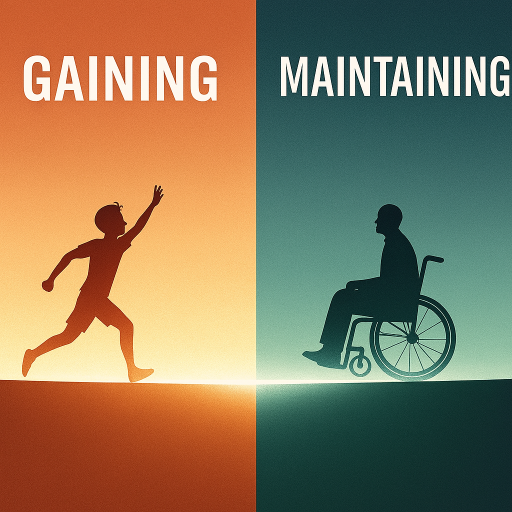
When we are young, most of the battles we choose are about growth. We fight to gain new skills, to build strength, to prove ourselves against the world. Every challenge feels like a step forward, every victory a new horizon. But as we grow older, the nature of the fight changes. The battles are no longer mainly about gaining. They are about maintaining. We fight not to lose the things we have worked so hard to earn: independence, health, dignity, and identity.
The Fight to Gain
In youth, the fight is expansive. We push outward. We fight to learn, to grow, and to prove ourselves. We learn to ride a bike, to master a language, to build a career, to find our place. We test our bodies, sharpen our minds, widen our circles, and imagine that possibility is almost endless.
At that stage of life, failure rarely feels final. If we fall short today, we believe we can try again tomorrow. The fight feels open-ended, full of movement and momentum. There is always another skill to learn, another door to push on, another horizon ahead.
The Fight to Maintain
With age, the fight begins to turn inward. Instead of chasing what we do not yet have, we begin fighting to hold on to what we already know matters.
We fight to keep moving, keep driving, keep wheeling, keep doing the ordinary things that make life feel like our own. We fight to hold on to memory, to relationships, to dignity, to the sense of self that can so easily be eroded by pain, time, illness, or the assumptions of others.
Loss feels different now. In youth, it often feels temporary. Later, each setback carries more weight. Each slip raises the question of whether this is something we will get back, or whether it is gone for good. The fight becomes quieter, but no less fierce. It is no longer about becoming more. Often, it is about not becoming less.
The Line of Enough
Somewhere in all of this, we draw a line - a marker of where we are enough.
Those who feel above that line can, at least for a while, see themselves as whole. They may still struggle, still hurt, still carry doubts, but they can look at their lives and believe they are enough as they are in that moment.
Those who feel below the line live differently. Doubt becomes heavier. Worth feels uncertain. The fight itself can begin to feel suspect, as though all the effort in the world may never be enough to lift them back above it.
The line is invisible, but it is powerful. It shapes how we measure ourselves, how we interpret our failures, and how we judge whether the struggle is still worth continuing. And it is not fixed. It shifts with age, loss, circumstance, pain, comparison, and perspective.
To maintain is not only to hold on to what we have, but also to keep ourselves above that line - to keep believing we are enough, even when the voices around us, and inside us, suggest otherwise.
The Emotional Shift
The hardest change is not always physical. Often, it is emotional.
In youth, the fight is fueled by ambition. We want more, and we believe more is possible. Later, the fight is often fueled by the fear of loss. We know what can be taken. We know how fragile ordinary life can be. We know how much of a person can be tied up in the things they are struggling to keep.
That shift makes the battle heavier. But it also gives it meaning. Fighting to preserve independence, love, dignity, or identity is not a lesser fight than the one for achievement. In many ways, it is a deeper one. It reveals the value of the things we are trying to protect.
What Endures
What changes over time is not the existence of the fight, but its object. In one season we fight to gain. In another we fight to maintain. The shape of the struggle changes, but the spirit beneath it remains.
To fight is to live. To fight is to resist surrender. To fight is to honour the life we have built and the self we are trying to keep intact.
Perhaps the truest fight of all is to stay above that shifting line of enough - to keep believing in our worth, even when pain, loss, or time try to tell us otherwise. What we fight for may change, but the act of fighting itself is what keeps us alive.