So, You Want to Be a Sysadmin
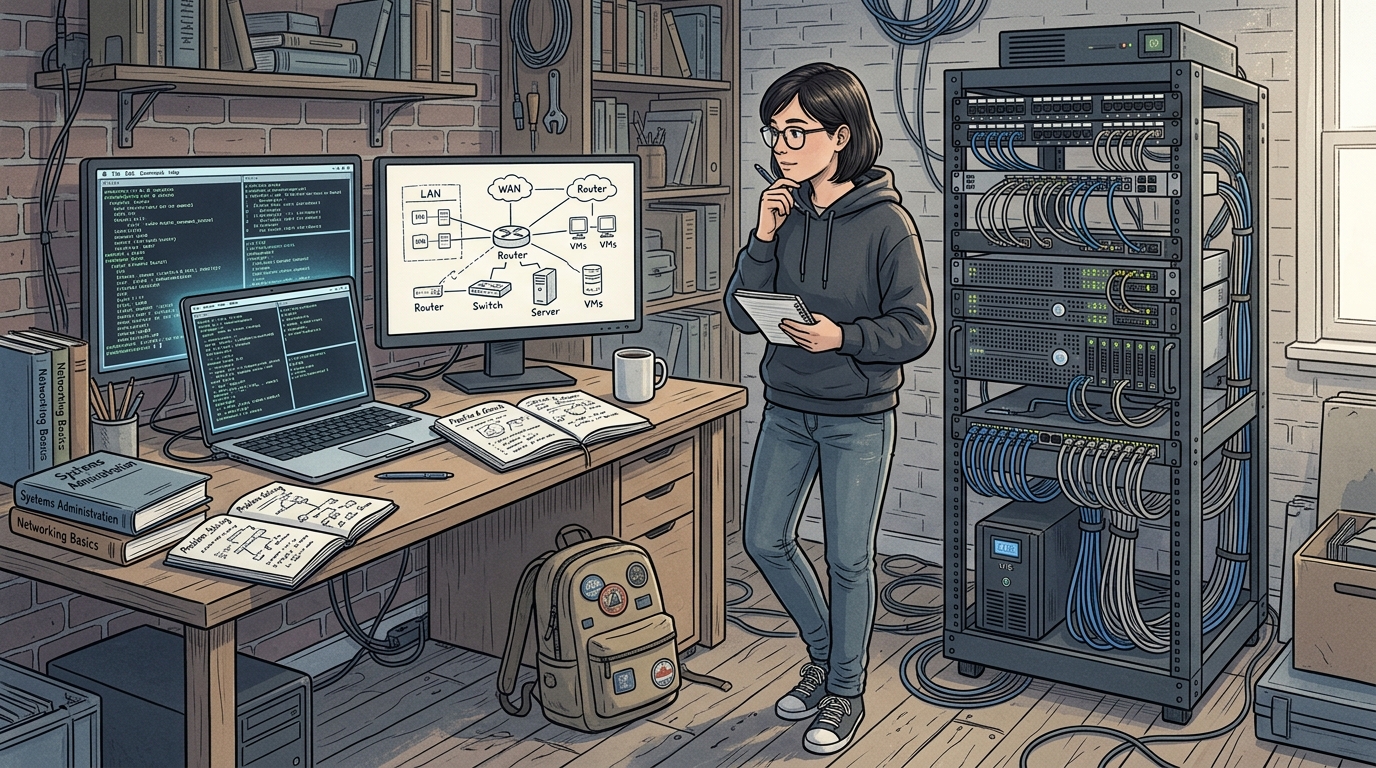
If you want to become a sysadmin, the first thing I would say is this: courses can help, but they are not the thing that will carry you.
A couple of relevant courses may help you get an interview. They may help your CV look more complete. They may help a recruiter decide that you are worth speaking to. That matters. Keywords matter. Familiarity matters. But courses alone will not get you through the door.
What gets you further is projects.
Projects give you something much more valuable than a course completion certificate. They give you stories. They give you mistakes. They give you problems you did not expect and the chance to work out what to do next. They prepare you for the conversation that really matters: the one with the technical people who are deciding whether they want you on their team.
That is where projects make the difference.
If you have built something, broken it, recovered it, and learned from it, you have something real to talk about. Even the mistakes help you, if you are honest about them. In some ways, the mistakes help more than the successes. What matters is not that everything went perfectly. What matters is how you recovered, what you learned, and whether the failure made you understand the problem more clearly than you did before.
That is the kind of thing people remember.
I know resourcing can be a problem. Not everyone has spare money for hardware or subscriptions. But a lot of platforms offer free tiers, trial periods, or credits. Use them. Build something. Even if the service never quite goes live, even if the project stays rough around the edges, you will still learn more than you would by never touching the technology at all.
That matters more than people think.
The other thing people are thinking about now is AI. Whether they are excited about it or scared of it, they are thinking about it. The impact it has on you and your job prospects will depend a lot on how you choose to use it.
My short version is simple: trust, but verify.
AI can help you move faster. It can help you gather information, compare options, draft configurations, explain unfamiliar tools, and speed up parts of the learning process. Used properly, it can be a very useful assistant. Used badly, it can make you careless.
If you blindly follow instructions from AI or the internet, you are putting yourself at risk. At that point you are not really solving problems. You are just assembling parts you do not fully understand. That is dangerous, not only because the instructions might be wrong. It is dangerous because it trains you not to think.
And if you stop thinking, you become replaceable in the worst possible way.
When I first started, the internet was still new enough that the key skills were often fairly simple. Where do I find the information? And then: how do I explain it to someone else in a way that makes sense?
Now the problem is different. There is too much information, not too little. So the skill is less about finding information and more about filtering out what is irrelevant, misleading, or incomplete. After that, you still have the same human task: how do I present the pros, the cons, the risks, the costs, and the trade-offs in a way that helps someone make a good decision?
That part has not changed.
People are still the reason we do what we do.
That is something I would want any new sysadmin to understand early. This job is not really about servers, or networks, or cloud platforms, or whatever the current fashionable tool happens to be. Those things matter, but they are not the reason the work exists. The work exists because people need systems that help them do something meaningful. Your job is to help make that possible.
If you want to thrive in IT, you need to care about the details, but you also need to care about the problem the details are trying to solve.
That is why I think problem solving matters more than credentials. If you focus on understanding the problem and finding a solution, you will always have options. If you do that long enough, you will also begin to develop instincts that you can trust. You will be able to look at a set of instructions and feel whether they make sense. You will be able to notice when something important is missing. You will be able to say, “Yes, this approach is sound,” or, “No, this feels wrong,” even before you can fully explain why.
That kind of judgment takes time, but it is worth building.
So if I were giving simple advice to an IT graduate who wants to become a sysadmin, it would be this:
Learn enough to get in the room. Build enough to have something real to say. Use AI, but never surrender your judgment to it. Care about people. Care about details. Solve problems. Learn from mistakes. Keep building.
The tools will keep changing. The need for clear thinking will not.
Anyway, I will shut up now. I hope this helps.