Layers
For most of my life I have been a systems builder and a problem solver. I thrive on helping people get things done.
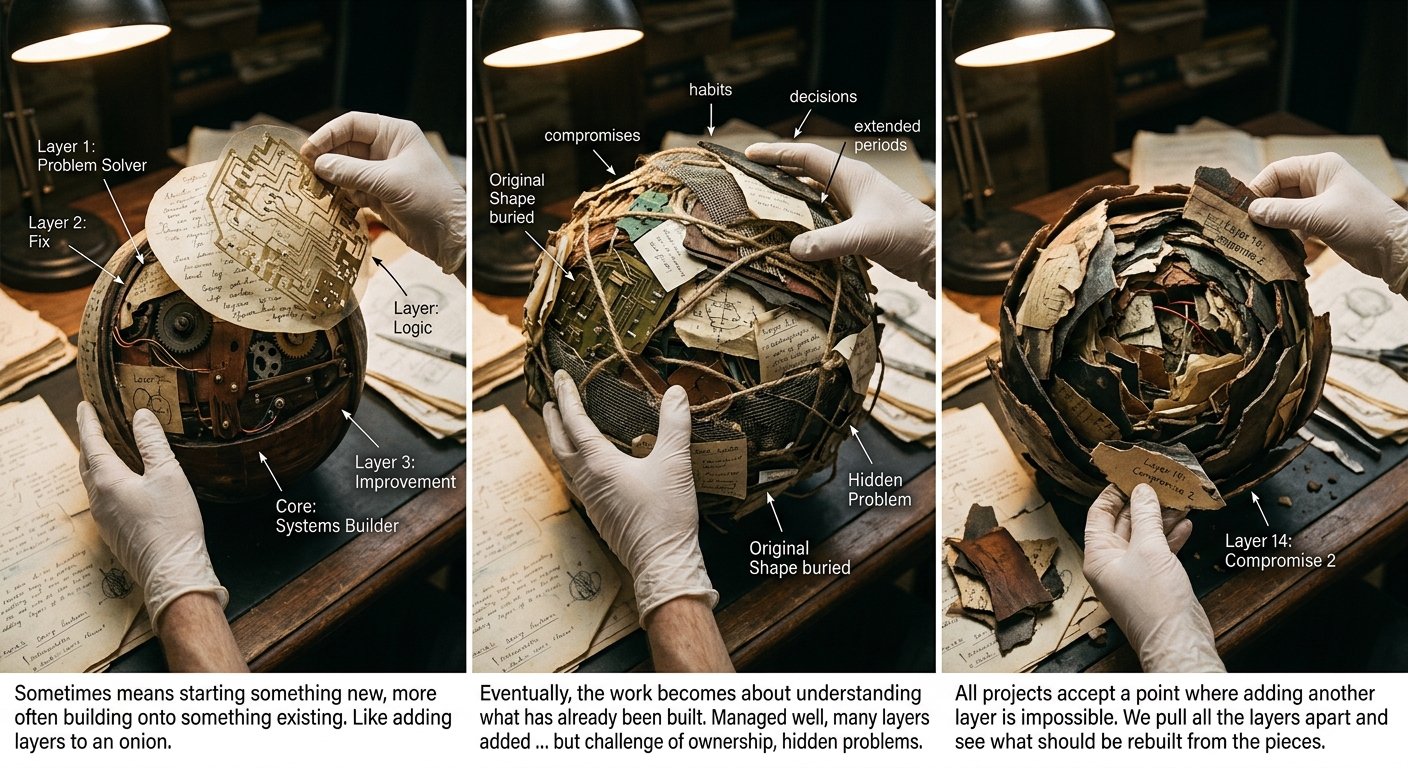
Sometimes this has meant starting something completely new, but more often than not it has meant building onto something that already exists. I often think of this as adding layers to an onion.
We are used to adding to things. We start with something — it almost doesn’t matter what — and then we add to it.
Some think adding fast is the key: making something “different,” hiding their starting point.
Others aim for quality, building slowly and taking their time. But they still add to the onion.
Strangely, most people do not naturally see that every layer changes the thing underneath.
Over time, the onion becomes harder to understand. The original shape is still there somewhere, but it is buried under decisions, fixes, improvements, compromises, and habits. Eventually, the work is no longer just about building. It becomes about understanding what has already been built.
This is often particularly apparent in research, where there can be extended periods with no activity on a project.
Managed well, many layers can be added to a project. But the challenge becomes knowing where a layer belongs, which layers are hiding significant problems, and who owns a particular layer.
Finally, all projects must accept that there will come a point where adding another layer either will not be possible, or will alter the project in ways that are no longer acceptable.
The question then becomes: do we stop, or do we pull all the layers apart and see what should be rebuilt from the pieces?